This is a record the attorney I am working under this summer wrote after one of her visits with Terri Schiavo. It is long for a blog post, but I wanted to share it with you.
February 24, 2005
Attorney Barbara Weller
I have visited Terri Schindler Schiavo several times since I first met her on the day before Christmas in 2004. Today was an especially poignant visit so I decided to again share it with all those who have been so concerned for her.
Attorney David Gibbs III and I visited Terri to update her on the good things that were happening in the legal case. We believe that she comprehends at some level what is going on and that she may well have been aware of the fear and anguish her parents and siblings were feeling on February 21 when the possibility existed that the process of starvation and dehydration might again be initiated leading to her death.
We made this visit with her mother and father, Bob and Mary Schindler. For the first time since I have been visiting her, security guards were posted by Terri’s door and visitors had to clear two check points before entering the room. The Schindlers are very grateful that Terri has been given this extra protection to keep her safe during this difficult time.
When Mr. Gibbs and I entered the room with Bob, Mary was already there. Terri was again sitting in her lounge chair, at nearly an upright angle. Mary was perched on the arm of the chair with her head right next to Terri’s head. Mary was talking to Terri and kissing her and Terri’s eyes were wide and locked onto her mother’s eyes. Mary was saying “I love you” and trying to get Terri to repeat the words after her. Mary would say “I-I-I-I” and Terri would answer back “Aa-a-u-u-ugh.” Mary would then say “l-o-o-o-v-v-v-v-e” and Terri would repeat “Aw-w-w-w-w-w.” Mary then said a staccato “you” to which Terri did not audibly respond.
Within a minute or two after we entered the room, Terri began to appear tired. She had been interacting with Mary for a half hour before we arrived and seemed to need a little rest. She closed her eyes while the four of us chatted. When Mary tried to get her attention, she would try to open her eyes, but they would flutter shut again. Mary was coaxing Terri to wake up, telling her that she had some “very important visitors” (Mr. Gibbs and myself). Finally, after a few minutes of coaxing, Terri’s eyes opened wide again and she again locked them on her mother’s face.
After a few minutes, Mr. Gibbs began to talk to her. When Terri heard Mr. Gibbs' voice she became startled. She threw her head backwards and made a loud snorting sound. While Mr. Gibbs continued to talk to her she was opening and closing her eyes, sometimes looking in his direction and sometimes appearing to be resting. Mr. Gibbs told her about the good things that were happening, about all the people around the world who love her and who are praying for her, and that the government had stepped in to protect her and to try to help her. He stressed, like you would to a small child, how blessed Terri was to have a mom and dad who loved her. Terri seemed quite content listening to Mr. Gibbs speak.
I next took a turn to talk with Terri. I went to the spot where her mother had been and began to talk quietly to her about the party we are all going to have when she goes home. I also prayed with her. The whole time I was speaking to her and praying for her, her eyes were wide open and fixated on my face. At one point, she tried to talk with me, making a very quiet “a-a-a-a-a” sound. I had the impression that my voice was perhaps somewhat familiar to her since I have now been to see her several times.
When her father went to stand by her side on Terri’s left, Mr. Gibbs had moved to her right, on the other side of Terri’s bed, which is next to her lounge chair. Earlier in Terri's room Bob had joked with Mr. Gibbs that everybody wanted to talk to Mr. Gibbs now and nobody cared what Bob had to say anymore making him jealous. Bob began to joke with Terri as he always does and Terri’s face took on the same coy, semi-annoyed look that I have seen before when she interacts with her father. At that point, Terri arched her back and turned her whole body to the right, away from Bob, to gaze intently at Mr. Gibbs with a little saucy smile on her face. It seemed obvious to me that she was playing along with the joke by giving her father the cold shoulder and focusing all her attention on Mr. Gibbs. Bob continued to tease with her about this for a few minutes and then gave her his customary hug and kiss, to which she responded with her usual lemon face that she reserves for his mustache kisses.
The four of us spent several more minutes joking and laughing together. Terri did not speak, but watched and listened to us. When it was time to go, Mary went up to Terri’s head to say goodbye. At that point Terri began to cry and to look very distressed. Mary said that Terri does not always cry when they leave, but she sometimes does. Mary promised that the whole family would return the next day, but Terri did not stop crying. When Mary left the room, I went up to Terri’s head and leaned close and told her that even though her mother and father could not always be with her that she was not alone. When I told her that, Terri widened her eyes again. She was no longer crying when I left the room.
This visit lasted about forty minutes. We encourage everyone to continue to pray for Terri and her family, especially that Terri will soon be receiving the help she needs to learn to speak and to swallow and that she will soon be home with her family again.
Thursday, August 03, 2006


Friday, July 07, 2006

Monday, July 03, 2006
Thoughts on Schiavo
During the whole Terri Schiavo mess I was skeptical about the way the Schindler family was handling the case and felt that the whole fight was being mischaracterized as a euthanasia case when it was actually just a custody battle, but I'm getting a little bit of a new angle now that I'm working at the firm that represented the Schindlers. Turns out it really was "just a custody battle" but that there was more going on below the surface. I don't know a whole lot about PVS, or about autopsies (maybe our medical friends can help us here), but it sounds to me like "vegetative" didn't really mean "vegetative" and some actors who should have been impartial got more personally invested in the procedural history of this case than justice allowed. It also sounds like medical determinations that should have been made by people in white coats were being made by people in black robes. All the right-to-life stuff in the media was a last-ditch effort to get a horrible, horrible lower court decision overturned when the procedural doors were closed, and the lesson perhaps we should learn (my analysis now, not to be mistaken for that of any parties or representatives thereof) is that maybe procedural doors shouldn't be so airtight (even in civil court) when finality of the decision is also finality of life.
Incidentally, David Gibbs' book Fighting For Dear Life came out today, and we'll probably be seeing and hearing him talk about it on national media over the next few weeks. (early review of the book)
Tangentially related, I noticed an article on New York Times today about another Terry (Terry Wallis) who suddenly "woke up" from PVS (kinda takes the "P" out of PVS, huh?) three years ago after being "mute and virtually unresponsive in a state of minimal consciousness" for 19 years. Good thing there was no custody battle over him. Quotation from the article:
Incidentally, David Gibbs' book Fighting For Dear Life came out today, and we'll probably be seeing and hearing him talk about it on national media over the next few weeks. (early review of the book)
Tangentially related, I noticed an article on New York Times today about another Terry (Terry Wallis) who suddenly "woke up" from PVS (kinda takes the "P" out of PVS, huh?) three years ago after being "mute and virtually unresponsive in a state of minimal consciousness" for 19 years. Good thing there was no custody battle over him. Quotation from the article:
I don't know; it sounds a little familiar. It seems like the Willis family would have filed an amicus brief or something in the Schiavo case, or that I at least would have heard of Terry sometime during the whole media furor. Was he talked about and I just missed it?"Mr. Wallis spent the second 19 years of his life at a nursing home in Mountain View, and family members who visited said they saw plenty of hints of awareness along the way. He seemed to brighten when they walked in his room. Something in his face would tighten when he was impatient or hungry."
Thursday, June 29, 2006
Inviting literary criticism
The Beautiful Lie
He was about four, I think... it was so long ago.
In a garden; he'd done some damage
behind a bright screen of sweet-peas
- snapped a stalk, a stake, I don't recall,
but the grandmother came and saw, and asked him:
"Did you do that?"
Now, if she'd said why did you do that,
he'd never have denied it. She showed him
he had a choice. I could see, in his face,
the new sense, the possible. That word and deed
need not match, that you could say the world
different, to suit you.
When he said "No", I swear it was as moving
as the first time a baby's fist clenches
on a finger, as momentous as the first
taste of fruit. I could feel his eyes looking
through a new window, at a world whose form
and colour weren't fixed
but fluid, that poured like a snake, trembled
around the edges like northern lights, shape-shifted
at the spell of a voice. I could sense him filling
like a glass, hear the unreal sea in his ears.
This is how to make songs, create men, paint pictures,
tell a story.
I think I made up the screen of sweet peas.
Maybe they were beans; maybe there was no screen,
it just felt as if there should be, somehow.
And he was my - no, I don't need to tell that.
I know I made up the screen. And I recall very well
what he had done.
-- Sheenagh Pugh
He was about four, I think... it was so long ago.
In a garden; he'd done some damage
behind a bright screen of sweet-peas
- snapped a stalk, a stake, I don't recall,
but the grandmother came and saw, and asked him:
"Did you do that?"
Now, if she'd said why did you do that,
he'd never have denied it. She showed him
he had a choice. I could see, in his face,
the new sense, the possible. That word and deed
need not match, that you could say the world
different, to suit you.
When he said "No", I swear it was as moving
as the first time a baby's fist clenches
on a finger, as momentous as the first
taste of fruit. I could feel his eyes looking
through a new window, at a world whose form
and colour weren't fixed
but fluid, that poured like a snake, trembled
around the edges like northern lights, shape-shifted
at the spell of a voice. I could sense him filling
like a glass, hear the unreal sea in his ears.
This is how to make songs, create men, paint pictures,
tell a story.
I think I made up the screen of sweet peas.
Maybe they were beans; maybe there was no screen,
it just felt as if there should be, somehow.
And he was my - no, I don't need to tell that.
I know I made up the screen. And I recall very well
what he had done.
-- Sheenagh Pugh
Wednesday, June 28, 2006
Any Vet groups reading this?
I apologize to all my loyal reader (love to ya, Monica) who apparently missed me. I've been busy Fighting For All That Is Good And Right (otherwise known as fighting to remember what all the pretty little buttons in Westlaw mean) as a law clerk (*ahem* intern) at Christian Law Association this week. I'd tell you how we are planning on Saving the World this summer, but then I'd have to kill you (or at least face some sort of confidentiality talking-to that might stay on my record), so instead I'll share an interesting circumstance a caller brought to our attention in the course of an unrelated call. Picture share (can be found at UMass-Dartmouth website):
In case you can't see exactly what this is, I'll explain: This is the front entrance to University of Massachusetts--Dartmouth campus. The flagpole in the center flies the Massachusetts state flag. On the right (yes, the right, not the center) is the United States flag. On the left is the rainbow flag, commonly known as the gay pride flag, and yes, it is being flown at the same height as the United States flag. Anyone want to play that game we learned from children's TV shows called "How Many Things Can You Find Wrong With This Picture"?
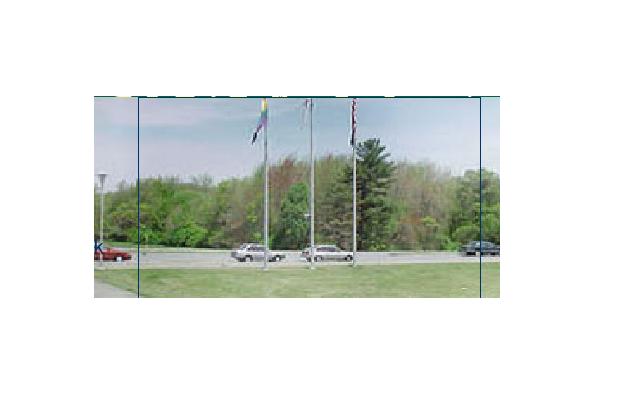
In case you can't see exactly what this is, I'll explain: This is the front entrance to University of Massachusetts--Dartmouth campus. The flagpole in the center flies the Massachusetts state flag. On the right (yes, the right, not the center) is the United States flag. On the left is the rainbow flag, commonly known as the gay pride flag, and yes, it is being flown at the same height as the United States flag. Anyone want to play that game we learned from children's TV shows called "How Many Things Can You Find Wrong With This Picture"?
Thursday, June 15, 2006

Wednesday, June 14, 2006
Rocks, hold your peace just yet
Coming to you live from an internet cafe in Phoenix...
The last few days I've been sitting in some very interesting lectures on some very interesting topics given by some very credentialed people, and I figured I should post something about a point they raised or a controversy they inspired, but in retrospect the strongest impression that stands out to me has nothing to do with those lectures.
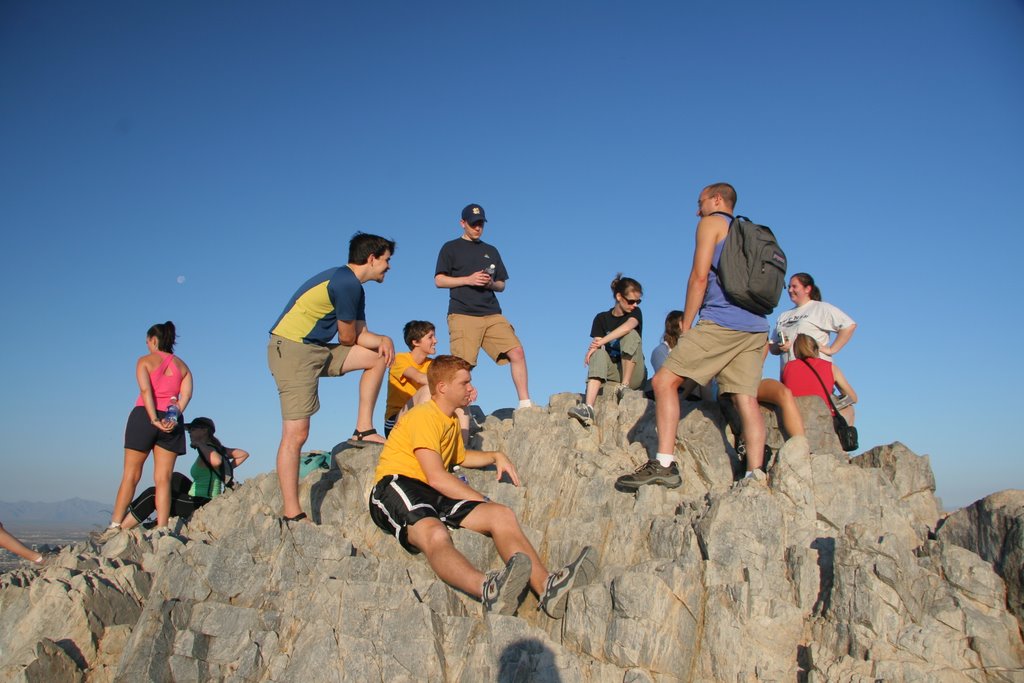
It happened this morning. A small group of us decided to go for a dawn hike up a nearby mountain since sessions started a little later. The timing worked out pretty well, and we reached the peak right about as the sun broke away from the horizon, and as all of us sat on the peak resting and basking in the beauty of Creation we started singing and reading aloud Psalms. It seemed like such a natural response none of us really thought twice about it. On the way back down, another hiker passed us. As he walked beside me for several paces he asked if we were a church group. I replied that no, we were law students, but we were Christians gathered from all over. He seemed absolutely baffled. "But you were singing up there," he said in puzzlement. "You're not a church?" But it's so logical: Christians gather, the Spirit is present; in the presence of so much natural beauty what could be more natural than that we be compelled to praise the Creator? I can't say for sure, but I don't think lost people really get that. Boy, do they miss out.
The last few days I've been sitting in some very interesting lectures on some very interesting topics given by some very credentialed people, and I figured I should post something about a point they raised or a controversy they inspired, but in retrospect the strongest impression that stands out to me has nothing to do with those lectures.
It happened this morning. A small group of us decided to go for a dawn hike up a nearby mountain since sessions started a little later. The timing worked out pretty well, and we reached the peak right about as the sun broke away from the horizon, and as all of us sat on the peak resting and basking in the beauty of Creation we started singing and reading aloud Psalms. It seemed like such a natural response none of us really thought twice about it. On the way back down, another hiker passed us. As he walked beside me for several paces he asked if we were a church group. I replied that no, we were law students, but we were Christians gathered from all over. He seemed absolutely baffled. "But you were singing up there," he said in puzzlement. "You're not a church?" But it's so logical: Christians gather, the Spirit is present; in the presence of so much natural beauty what could be more natural than that we be compelled to praise the Creator? I can't say for sure, but I don't think lost people really get that. Boy, do they miss out.
Tuesday, June 06, 2006
Sermon in Verse
Down With Fanatics!
If I had my way with violent men
I'd simmer them in oil,
I'd fill a pot with bitumen
And bring them to the boil.
I execrate the terrorist
And those who harbour him,
And if I weren't a moralist
I'd tear them limb from limb.
Fanatics are an evil breed
Whom decent men should shun;
I'd like to flog them till they bleed,
Yes, every mother's son,
I'd like to tie them to a board
And let them taste the cat,
While giving praise, oh thank the Lord,
That I am not like that.
For we should love the human kind,
As Jesus taught us to,
And those who don't should be struck blind
And beaten black and blue;
I'd like to roast them in a grill
And listen to them shriek,
Then break them on the wheel until
They turned the other cheek.
-- Roger Woddis
If I had my way with violent men
I'd simmer them in oil,
I'd fill a pot with bitumen
And bring them to the boil.
I execrate the terrorist
And those who harbour him,
And if I weren't a moralist
I'd tear them limb from limb.
Fanatics are an evil breed
Whom decent men should shun;
I'd like to flog them till they bleed,
Yes, every mother's son,
I'd like to tie them to a board
And let them taste the cat,
While giving praise, oh thank the Lord,
That I am not like that.
For we should love the human kind,
As Jesus taught us to,
And those who don't should be struck blind
And beaten black and blue;
I'd like to roast them in a grill
And listen to them shriek,
Then break them on the wheel until
They turned the other cheek.
-- Roger Woddis
Monday, May 29, 2006

Friday, May 26, 2006
Book reports
The Peacemaker, by Ken Sande
When I picked this book up I thought it would be more about arbitration and mediation with a Christian twist (based entirely on the prohibition against taking other Christians to court in I Cor. 6:1-8). While that passage is referenced a few times in the book, its scope is much more broad than that. Sande has a lot of good points about the inability of courts to address underlying problems in disputes and the damage this can cause in relationships among believers, but I really like the book's positive focus on what the church can, and should, do about it. He encourages churches to take an active role in maintaining healthy relationships within the church by overseeing conflict resolution and reconciliation. Most notable about this book is that it is not really about "legal" disputes. It is about relationships and ALL the conflicts that go with them, whether it's the breakdown of a contract, of a marriage, or kids fighting over the front seat of the car. It was challenging to me on a personal level because it pointed out the positive effects of conflict--greater understanding of and interaction with fellow-believers, and growth from the ability to reach God-honoring solutions. I don't like conflict and tend to deny it, run from it, or ignore it, and that is just as unhealthy to a relationship as belligerence. This book gets lots of stars on a scale of lots of stars.
Humility: True Greatness, by C.J. Mahaney
This book reminded me of one of those little coffee-table-type inspirational books you sometimes see at the checkout. I don't mean that in a disparaging way. It has good substance, even if it is a little repetitive and sometimes reads like an annotated bibliography. If you need a quick reminder and refocus on your exact position with reference to God (and who are we kidding, don't we all?), this book is a good choice. Watch out for some overt Calvinism, if that sort of thing bothers you. A respectable number of stars out of lots of stars.
When I picked this book up I thought it would be more about arbitration and mediation with a Christian twist (based entirely on the prohibition against taking other Christians to court in I Cor. 6:1-8). While that passage is referenced a few times in the book, its scope is much more broad than that. Sande has a lot of good points about the inability of courts to address underlying problems in disputes and the damage this can cause in relationships among believers, but I really like the book's positive focus on what the church can, and should, do about it. He encourages churches to take an active role in maintaining healthy relationships within the church by overseeing conflict resolution and reconciliation. Most notable about this book is that it is not really about "legal" disputes. It is about relationships and ALL the conflicts that go with them, whether it's the breakdown of a contract, of a marriage, or kids fighting over the front seat of the car. It was challenging to me on a personal level because it pointed out the positive effects of conflict--greater understanding of and interaction with fellow-believers, and growth from the ability to reach God-honoring solutions. I don't like conflict and tend to deny it, run from it, or ignore it, and that is just as unhealthy to a relationship as belligerence. This book gets lots of stars on a scale of lots of stars.
Humility: True Greatness, by C.J. Mahaney
This book reminded me of one of those little coffee-table-type inspirational books you sometimes see at the checkout. I don't mean that in a disparaging way. It has good substance, even if it is a little repetitive and sometimes reads like an annotated bibliography. If you need a quick reminder and refocus on your exact position with reference to God (and who are we kidding, don't we all?), this book is a good choice. Watch out for some overt Calvinism, if that sort of thing bothers you. A respectable number of stars out of lots of stars.
Tuesday, May 23, 2006
Books for fun
Well, it's officially summer for most of us student-types, so that means it's reading-things-other-than-textbooks season. Blackstone has sent me what looks like a fantastic set of additions to my library, there are some other new books on my shelves waiting to be explored, and of course there are some old friends there who need to be revisited. Books in the first category:
- Confessions, by A. Augustine
- Always Ready, by Greg L. Bahnsen
- Coercing Virtue, by Robert Bork
- Natural Law for Lawyers, by J. Budziszewski
- Orthodoxy, by G.K. Chesterton
- America's Christian History, by Gary DeMar
- Architects of the Culture of Death, by Donald DeMarco & Benjamin Wiker
- The Cruelty of Heresy, by C. Fitzsimons Allison
- No Other God, by John Frame
- The Abolition of Man, by C.S. Lewis
- Humility: True Greatness, by C.J. Mahaney
- The Heritage Guide to the Constitution, by Edwin Meese III
- Christ and Culture, by H. Richard Neibuhr
- When I Don't Desire God, by John Piper
- The Peacemaker, by Ken Sande
- Idols for Destruction, by Herbert Scholssberg,
- The Homosexual Agenda, by Alan Sears and Craig Osten
- ACLU vs. America, by Alan Sears and Craig Osten
- Sir William Blackstone & the Common Law, by Robert Stacey
- The Cube and the Cathedral, by George Weigel
- Vindicating the Founders, by Tom West
Books in the second category:
- One Hundred Years of Solitude (which my roommate just gave me--can't wait!)
- Huckleberry Finn (which I am ashamed to say I have never read)
- Understanding the Times
A FEW books in the third category:
- To Kill a Mockingbird (just saw the movie at DPAC and really need to reread it)
- Wuthering Heights (it's just been a while)
- The Grapes of Wrath
- Cry, the Beloved Country
- something by Jane Austin
So what are you guys reading?
Wednesday, May 10, 2006
Chieftains pictures
For you who are interested, they finally have a few pictures up on the DPAC website from the NDSOrchestra/Chieftains concert. I don't think I'm in any of the ones from Carnegie Hall, but I was there, I promise.
Edit: Oh wait, I'm in some of the rehearsal pics from Carnegie Hall. See, told you I was there.
Edit: Oh wait, I'm in some of the rehearsal pics from Carnegie Hall. See, told you I was there.
Wednesday, May 03, 2006
More sniping at cnn.com
Note to CNN: Polygamy is having more than one wife. Polyandry is having more than one husband. They are not the same, whatever any statute may be titled and however it might be applied. Check your Greek and Latin, folks.
More Kent
 Here's Baby Kent in all his glory. Not bad, if I may say so myself. If he's lucky, he'll take after his aunt. ;-)
First pictures of Kent

This is what is known in socioeconomics as a nuclear family unit.

This is what is known in family law as a potentially good situation.
Tuesday, May 02, 2006
New Phillips
Congratulations to my brother and sister-in-law for successfully creating another Phillips to populate the world. Kent Alan was born this afternoon about 3:00, at 20 1/2 inches and 7lbs., 14 oz. Pictures to follow.
Friday, April 28, 2006
Gas price sanity
While economics may be far from the normal topics of this blog, the gripes, "expert" commentary, and political pandering surrounding the continued rise in gas prices have promted me to finally exercise my posting privilieges. The link below is to the best, most concise explanation of the problem I have yet seen.
As the link shows, the columnist does little more than remind that that no matter how much the people scream and the politicans promise, the laws of supply and demand cannot be repealed. Are oil companies charging as much as then market will bear? Sure, but so does every single business and so does every single employee who looks for a raise. Countless investigations have found no collusion among the oil companies, and if they had, that would be an issue for Antitrust law, not the griping we hear today.
What irritates me most is that the same people responsible for the supply and demand problems are those scream the loudest over the prices. We might want to drive SUVs, regulate the blends of gasoline, or not drill in certain places because we like the look of tundra more than lower oil prices. But those decisions come at a cost, and politicans who created those costs by impacting supply and demand are now blaming everyone but the responsible parties: themselves. The least they could do is be honest.
Indeed, all the political sound and fury is counter-productive, because it only increases people's fear that prices will go higher. I have heard that the "future uncertainty" premium is at least$10, and maybe $20 per barrel of oil. Fear drives prices even higher by unreasonably increasing demand now, and adding to the fear does not help.
Link to article
As the link shows, the columnist does little more than remind that that no matter how much the people scream and the politicans promise, the laws of supply and demand cannot be repealed. Are oil companies charging as much as then market will bear? Sure, but so does every single business and so does every single employee who looks for a raise. Countless investigations have found no collusion among the oil companies, and if they had, that would be an issue for Antitrust law, not the griping we hear today.
What irritates me most is that the same people responsible for the supply and demand problems are those scream the loudest over the prices. We might want to drive SUVs, regulate the blends of gasoline, or not drill in certain places because we like the look of tundra more than lower oil prices. But those decisions come at a cost, and politicans who created those costs by impacting supply and demand are now blaming everyone but the responsible parties: themselves. The least they could do is be honest.
Indeed, all the political sound and fury is counter-productive, because it only increases people's fear that prices will go higher. I have heard that the "future uncertainty" premium is at least$10, and maybe $20 per barrel of oil. Fear drives prices even higher by unreasonably increasing demand now, and adding to the fear does not help.
Link to article
The circus continues
And now to tie two posts together, I bring you a link that discusses the jury deliberations for the capital punishment sentencing of Moussaoui. The article opens:
The judge in Zacarias Moussaoui's death penalty trial admonished jurors Friday to avoid looking up words in the dictionary after learning that one went on the Internet to see what "aggravating" means.My word. This calls into question all kinds of things (jury instructions, clarity of the lawyer's arguments, value of a 'jury of our peers'...).
Monday, April 24, 2006
Git yer tikits
You have less than a week left to get your tickets for the ND Symphony Orchestra Spring Concert on Friday at 8. Come on, you know you need a break from studying, and a little culture never hurt anyone.
Saturday, April 22, 2006
Subscribe to:
Posts (Atom)