Tuesday, August 29, 2006

Fatalism or sanity?

From Anthony Trollope in Can You Forgive Her?:

People often say that marriage is an important thing, and should be much thought of in advance, and marrying people are cautioned that there are many who marry in haste and repent at leisure. I am not sure, however, that marriage may not be pondered over too much; nor do I feel certain that the leisurely repentance does not as often follow the leisurely marriage as it does the rapid ones. That some repent no one can doubt, but I am incline to believe that most men and women take their lots as they find them, marrying as the birds do by force of nature, and going on with their mates with a general, though not perhaps an undisturbed satisfaction, feeling inwardly assured that Providence, if it has not done the very best for them, has done for them as well as they could do for themselves with all the thought in the world. I do not know that a woman can assure to herself, by her own prudence and taste, a good husband any more than she can add two cubits to her stature; but husbands have been made to be decently good,--and wives too, for the most part, in our country,--so that the thing does not require quite so much thinking as some people say.
[Quoted in Schneider and Brinig, An Invitation to Family Law]

What think you of this? Perspectives from married folk? Charlotte Lucas?

Shoutout to Frittering

I'd like to report that with school back in session, we at Frittering Away are back to frittering with abandon, so you who left off visiting during the dry summer months will be happy to know you can once again enjoy the witticisms of professors, school teachers, and students (grade school and grad) without the pain of actually having to attend school.

Saturday, August 26, 2006

Not separate, but still not equal?

Thought prompted by discussion in Law of Ed...

People often use or understand the dogma that there is no such thing as "separate but equal" to stand for the proposition that integration necessarily implies equality. I vaguely remember from Logic that there is some Latin term for this sort of fallacy (B = ~A, therefore ~B = A), but I can't for the life of me remember the term. At any rate, it's not sound reasoning from a logic standpoint.

Aside from Latin and logic, anyway, can the conclusion be disproved by demonstration? Anecdotal evidence suggests that the consolidated school system often fosters a system of stratification among the students such that the students at the top and the bottom of the performance curve (or just the top) receive the benefit of a far greater proportion of school resources than students in the middle. Is this inequality, and if so, should we be troubled by it?

One of my schoolmates raises the compelling point that at least integration has produced some equality of opportunity, and since all the resources are available on a merit basis, any ceilings on educational opportunities are self-imposed.

While I would grant that integration was probably a positive step, though, I'm still not entirely sanguine about accepting the "equality of opportunity" as ideal. First, at least in my experience, the disparity of resources spent on "exceptional" students vs. "average" students ranges from unfair to shocking. Second, while autonomy and responsibility for one's own performance are to be highly valued, we are still talking about children, or at best, adolescents. They are still in their formative years, and as such, still ought to have access to formative forces without too much expectation that they will already have it all together. If we thought they were mature enough to bear the full consequences of their priority decisions, we probably wouldn't have truancy laws or legal concessions for minority. And as much as we might hate to admit it, there is a strong correlation between socio-economic status and academic success. I don't think the correlation is that poor kids are all lazy and unmotivated or stupid. Should we hold them responsible for whatever the correlation is? Do we have any choice?

Friday, August 25, 2006

Yes, there are nice people at OSU

Greetings to Brian, a fellow Blackstone Legal Intern at Ohio State. Welcome to your blog Standing in the Gap now on the sidebar. Sorry about your football team...

Thursday, August 24, 2006

More Introductions

Two new characters on the scene (and a walk-on)...

First, welcome my new roommate Carissa to NDLaw. Her blog Meldisse is new on the sidebar.

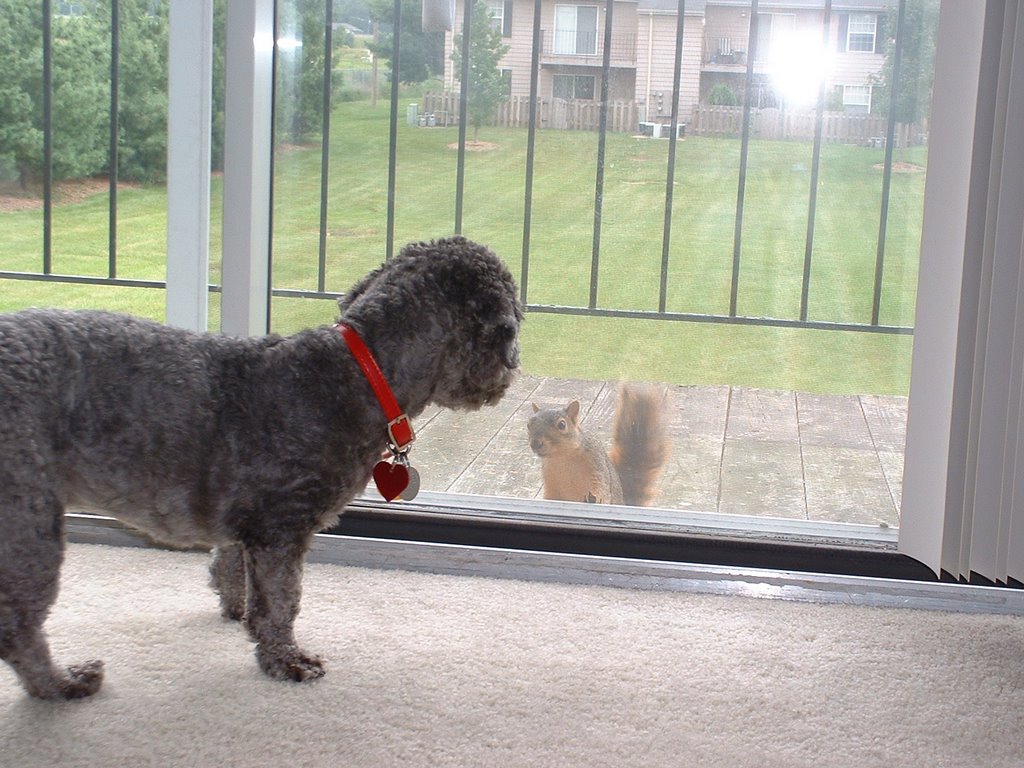
Second, meet Cricket the pseudo-minipoodle. He's still getting adjusted to apartment life (and life outside the pound in general, I'm afraid). Today he met a rather bold squirrel that was investigating the (also new) birdfeeder I just hung outside.

Wednesday, August 23, 2006

Free *newsletter article* signing Thursday

Check it out! I'm famous (in a completely nameless sort of way)! I wrote that article as an intern at CLA this summer!

More from abroad

Please welcome on the right bar Doosan 1803, the blog of my former schoolmate Delaura Talbert. Look there for adventures of an American teaching 6th grade at a Christian school in South Korea.

Note also that you will find a similar plot line at Dancing Through Life (Joanna's blog). Best to you both, girls! Wish I could be there.

Monday, August 21, 2006

Coming Attractions

About two years ago a young couple from our church was teaching in a school in Ivory Coast when that country's political stability dissintegrated nearly overnight and they had to evacuate via a harrowing two-day excursion with a French military convoy. It was at least the second time in recent history the school had had to be evacuated because of a resurfacing civil war, and this time the school board decided not to reopen. Now the couple from our church is serving a missionary school in the city (?) of Niamey in Niger, West Africa, where many of their students from Ivory Coast moved.

This year a small group from my church in Florida plans to spend about a week and a half in Niamey visiting our friends and helping a local French school (not the one they are employed at) by building desks and reroofing their building. We plan to leave the day after Christmas, have a two-day layover in Casablanca, Morocco, and then spend until January 5 in Niamey. I'll try to have pictures to share. No doubt stories will arise as well. Niger is 90% Muslim, has a population density of 28/sq. mi. (about 14 million total), and a per capita GDP (adjusted for PPP) of $872. Most of it is desert (Sahara), and they tell me the sand is so bad you have to learn to chew differently so as not to grind down your teeth.

I would appreciate your prayers as I work out the details (financial and logistical--do you know how many shots you have to have to go to West Africa!?).

The Wheels on the Bus Go Round and Round.

To all my classmates, and to students everywhere, welcome back to school. To those who love (or merely tolerate) the students in their lives, my sympathies for you. Indulge our self-centeredness for a couple of weeks, then kindly kick us back into perspective.

Sorry for the sparse posting this summer; I've been happily crabby and unsociable for much of it, and my interactive skills need a little dusting. Hopefully new classes and discussion with my ever-brilliant colleagues will spark more regular posting in the coming months. Look for musings on Family Law, Education Law, and maybe even a little Tax Law (I'll try hard to keep those at least vaguely relevent to "normal" people).

Oh, did anyone notice that the Notre Dame football team is ranked No. 3 (tied with USC) this year?

Friday, August 04, 2006

And I am left to wonder how many other people care.

Last Visit Narrative
by Attorney Barbara Weller

When Terri Schiavo’s feeding tube was removed at 1:45 p.m. on March 18, 2005, I was one of the most surprised people on the planet. I had been visiting Terri throughout the morning with her family and her priest. As part of the legal team working throughout the previous days and nights to save Terri from a horrific fate, I was very hopeful. Although the state judicial system had obviously failed Terri by not protecting her life, I knew other forces were still at work. I fully expected the federal courts would step in to reverse this injustice, just as they might for a prisoner unjustly set for execution—although by much more humane means than Terri would be executed. Barring that, I was certain that sometime around noon, the Florida Department of Children and Family Services would come to the Woodside Hospice facility in Pinellas Park and take Terri into protective custody. Or that federal marshals would arrive from Washington D.C, where the Congress was working furiously to try to save Terri, and would stand guard at her door to prevent any medical personnel from entering her room to remove the tube that was providing her nutrition and hydration.

Finally, I was sure if nothing else was working, that at 12:59, just before the hour scheduled for Terri’s gruesome execution to begin, Florida Gov. Jeb Bush would at least issue a 60-day reprieve for the legislative bodies to complete the work they were attempting to do to save Terri’s life and to make sure that no other vulnerable adults could be sentenced to starve to death in America. I had done the legal research weeks before and was fully convinced that Gov. Bush had the power, under our co-equal branches of government, to issue a reprieve in the face of a judicial death sentence intended to lead to the starvation and dehydration of an innocent woman when scores of doctors and neurologists were saying she could be helped.

All morning long, as I was in the room with Terri and her family, we were telling her that help was on the way. Terri was in good spirits that morning. The mood in her room was jovial, particularly around noontime, as we knew Congressional attorneys were on the scene and many were working hard to save Terri’s life. For most of that time, I was visiting and talking with Terri along with Terri’s sister Suzanne Vitadamo, Suzanne’s husband, and Terri’s aunt, who was visiting from New York to help provide support for the family. A female Pinellas Park police office was stationed at the door outside Terri’s room.

Terri was sitting up in her lounge chair, dressed and looking alert and well. Her feeding tube had been plugged in around 11 a.m. and we all felt good that she was still being fed. Suzanne and I were talking, joking, and laughing with Terri, telling her she was going to go to Washington D.C. to testify before Congress, which meant that finally Terri’s husband Michael would be required to fix her wheelchair. After that Suzanne could take Terri to the mall shopping and could wheel her outdoors every day to feel the wind and sunshine on her face, something she has not been able to do for more than five years.

At one point, I noticed Terri’s window blinds were pulled down. I went to the window to raise them so Terri could look at the beautiful garden outside her window and see the sun after several days of rain. As sunlight came into the room, Terri’s eyes widened and she was obviously very pleased. At another point, Suzanne and I told Terri she needed to suck in all the food she could because she might not be getting anything for a few days. During that time, Mary Schindler, Terri’s mother, joined us for a bit, and we noticed there were bubbles in Terri’s feeding tube. We joked that we didn’t want her to begin burping, and called the nurses to fix the feeding tube, which they did. Terri’s mother did not come back into the room. This was a very difficult day for Bob and Mary Schindler. I suspect they were less hopeful all along than I was, having lived through Terri’s last two feeding tube removals.

Suzanne and I continued to talk and joke with Terri for probably an hour or more. At one point Suzanne called Terri the bionic woman and I heard Terri laugh out loud heartily for the first time since I have been visiting with her. She laughed so hard that for the first time I noticed the dimples in her cheeks.

The most dramatic event of this visit happened at one point when I was sitting on Terri’s bed next to Suzanne. Terri was sitting in her lounge chair and her aunt was standing at the foot of the chair. I stood up and learned over Terri. I took her arms in both of my hands. I said to her, “Terri if you could only say ‘I want to live’ this whole thing could be over today.” I begged her to try very hard to say, “I want to live.” To my enormous shock and surprise, Terri’s eyes opened wide, she looked me square in the face, and with a look of great concentration, she said, “Ahhhhhhh.” Then, seeming to summon up all the strength she had, she virtually screamed, “Waaaaaaaa.” She yelled so loudly that Michael Vitadamo, Suzanne’s husband, and the female police officer who were then standing together outside Terri’s door, clearly heard her. At that point, Terri had a look of anguish on her face that I had never seen before and she seemed to be struggling hard, but was unable to complete the sentence. She became very frustrated and began to cry. I was horrified that I was obviously causing Terri so much anguish. Suzanne and I began to stroke Terri’s face and hair to comfort her. I told Terri I was very sorry. It had not been my intention to upset her so much. Suzanne and I assured Terri that her efforts were much appreciated and that she did not need to try to say anything more. I promised Terri I would tell the world that she had tried to say, ”I want to live.”

Suzanne and I continued to visit and talk with Terri, along with other family members who came and went in the room, until about 2:00 p.m. when we were all told to leave after Judge Greer denied yet another motion for stay and ordered the removal of the feeding tube to proceed. As we left the room, the female police officer outside the door was valiantly attempting to keep from crying.

Just as Terri’s husband Michael has told the world he must keep an alleged promise to kill Terri, a promise remembered a million dollars and nearly a decade after the fact; I must keep my promise to Terri immediately. Time is running out for her. I went out to the banks of cameras outside the hospice facility and told the story immediately. Now I must also tell the story in writing for the world to hear. It may be the last effective thing I can do to try to keep Terri alive so she can get the testing, therapy, and rehabilitative help she so desperately needs before it is too late.

About four in the afternoon, several hours after the feeding tube was removed, I returned to Terri’s room. By that time she was alone except for a male police officer now standing inside the door. When I entered the room and began to speak to her, Terri started to cry and tried to speak to me immediately. It was one of the most helpless feelings I have ever had. Terri was looking very melancholy at that point and I had the sense she was very upset that we had told her things were going to get better, but instead, they were obviously getting worse. I had previously had the same feeling when my own daughter was a baby who was hospitalized and was crying and looking to me to rescue her from her hospital crib, something I could not do. While I was in the room with Terri for the next half hour or so, several other friends came to visit and I did a few press interviews sitting right next to Terri. I again raised her window shade, which had again been pulled down, so Terri could at least see the garden and the sunshine from her lounge chair. I also turned the radio on in her room before I left so that when she was alone, she would at least have some music for comfort.

Just before I left the room, I leaned over Terri and spoke right into her ear. I told her I was very sorry I had not been able to stop the feeding tube from being taken out and I was very sorry I had to leave her alone. But I reminded her that Jesus would stay right by her side even when no one else was there with her. When I mentioned Jesus’ Name, Terri again laughed out loud. She became very agitated and began loudly trying to speak to me again. As Terri continued to laugh and try to speak, I quietly prayed in her ear, kissed her, placed her in Jesus’ care, and left the room.

Terri is alone now. As I write this last visit narrative, it is five in the morning of March 19. Terri has been without food and water for nearly 17 hours. I’m sure she is beginning at least to become thirsty, if not hungry. And I am left to wonder how many other people care.

Thursday, August 03, 2006

A visit with Terri

This is a record the attorney I am working under this summer wrote after one of her visits with Terri Schiavo. It is long for a blog post, but I wanted to share it with you.

February 24, 2005
Attorney Barbara Weller

I have visited Terri Schindler Schiavo several times since I first met her on the day before Christmas in 2004. Today was an especially poignant visit so I decided to again share it with all those who have been so concerned for her.

Attorney David Gibbs III and I visited Terri to update her on the good things that were happening in the legal case. We believe that she comprehends at some level what is going on and that she may well have been aware of the fear and anguish her parents and siblings were feeling on February 21 when the possibility existed that the process of starvation and dehydration might again be initiated leading to her death.

We made this visit with her mother and father, Bob and Mary Schindler. For the first time since I have been visiting her, security guards were posted by Terri’s door and visitors had to clear two check points before entering the room. The Schindlers are very grateful that Terri has been given this extra protection to keep her safe during this difficult time.

When Mr. Gibbs and I entered the room with Bob, Mary was already there. Terri was again sitting in her lounge chair, at nearly an upright angle. Mary was perched on the arm of the chair with her head right next to Terri’s head. Mary was talking to Terri and kissing her and Terri’s eyes were wide and locked onto her mother’s eyes. Mary was saying “I love you” and trying to get Terri to repeat the words after her. Mary would say “I-I-I-I” and Terri would answer back “Aa-a-u-u-ugh.” Mary would then say “l-o-o-o-v-v-v-v-e” and Terri would repeat “Aw-w-w-w-w-w.” Mary then said a staccato “you” to which Terri did not audibly respond.

Within a minute or two after we entered the room, Terri began to appear tired. She had been interacting with Mary for a half hour before we arrived and seemed to need a little rest. She closed her eyes while the four of us chatted. When Mary tried to get her attention, she would try to open her eyes, but they would flutter shut again. Mary was coaxing Terri to wake up, telling her that she had some “very important visitors” (Mr. Gibbs and myself). Finally, after a few minutes of coaxing, Terri’s eyes opened wide again and she again locked them on her mother’s face.

After a few minutes, Mr. Gibbs began to talk to her. When Terri heard Mr. Gibbs' voice she became startled. She threw her head backwards and made a loud snorting sound. While Mr. Gibbs continued to talk to her she was opening and closing her eyes, sometimes looking in his direction and sometimes appearing to be resting. Mr. Gibbs told her about the good things that were happening, about all the people around the world who love her and who are praying for her, and that the government had stepped in to protect her and to try to help her. He stressed, like you would to a small child, how blessed Terri was to have a mom and dad who loved her. Terri seemed quite content listening to Mr. Gibbs speak.

I next took a turn to talk with Terri. I went to the spot where her mother had been and began to talk quietly to her about the party we are all going to have when she goes home. I also prayed with her. The whole time I was speaking to her and praying for her, her eyes were wide open and fixated on my face. At one point, she tried to talk with me, making a very quiet “a-a-a-a-a” sound. I had the impression that my voice was perhaps somewhat familiar to her since I have now been to see her several times.

When her father went to stand by her side on Terri’s left, Mr. Gibbs had moved to her right, on the other side of Terri’s bed, which is next to her lounge chair. Earlier in Terri's room Bob had joked with Mr. Gibbs that everybody wanted to talk to Mr. Gibbs now and nobody cared what Bob had to say anymore making him jealous. Bob began to joke with Terri as he always does and Terri’s face took on the same coy, semi-annoyed look that I have seen before when she interacts with her father. At that point, Terri arched her back and turned her whole body to the right, away from Bob, to gaze intently at Mr. Gibbs with a little saucy smile on her face. It seemed obvious to me that she was playing along with the joke by giving her father the cold shoulder and focusing all her attention on Mr. Gibbs. Bob continued to tease with her about this for a few minutes and then gave her his customary hug and kiss, to which she responded with her usual lemon face that she reserves for his mustache kisses.

The four of us spent several more minutes joking and laughing together. Terri did not speak, but watched and listened to us. When it was time to go, Mary went up to Terri’s head to say goodbye. At that point Terri began to cry and to look very distressed. Mary said that Terri does not always cry when they leave, but she sometimes does. Mary promised that the whole family would return the next day, but Terri did not stop crying. When Mary left the room, I went up to Terri’s head and leaned close and told her that even though her mother and father could not always be with her that she was not alone. When I told her that, Terri widened her eyes again. She was no longer crying when I left the room.

This visit lasted about forty minutes. We encourage everyone to continue to pray for Terri and her family, especially that Terri will soon be receiving the help she needs to learn to speak and to swallow and that she will soon be home with her family again.

Friday, July 07, 2006

Monday, July 03, 2006

Thoughts on Schiavo

During the whole Terri Schiavo mess I was skeptical about the way the Schindler family was handling the case and felt that the whole fight was being mischaracterized as a euthanasia case when it was actually just a custody battle, but I'm getting a little bit of a new angle now that I'm working at the firm that represented the Schindlers. Turns out it really was "just a custody battle" but that there was more going on below the surface. I don't know a whole lot about PVS, or about autopsies (maybe our medical friends can help us here), but it sounds to me like "vegetative" didn't really mean "vegetative" and some actors who should have been impartial got more personally invested in the procedural history of this case than justice allowed. It also sounds like medical determinations that should have been made by people in white coats were being made by people in black robes. All the right-to-life stuff in the media was a last-ditch effort to get a horrible, horrible lower court decision overturned when the procedural doors were closed, and the lesson perhaps we should learn (my analysis now, not to be mistaken for that of any parties or representatives thereof) is that maybe procedural doors shouldn't be so airtight (even in civil court) when finality of the decision is also finality of life.

Incidentally, David Gibbs' book Fighting For Dear Life came out today, and we'll probably be seeing and hearing him talk about it on national media over the next few weeks. (early review of the book)

Tangentially related, I noticed an article on New York Times today about another Terry (Terry Wallis) who suddenly "woke up" from PVS (kinda takes the "P" out of PVS, huh?) three years ago after being "mute and virtually unresponsive in a state of minimal consciousness" for 19 years. Good thing there was no custody battle over him. Quotation from the article:

"Mr. Wallis spent the second 19 years of his life at a nursing home in Mountain View, and family members who visited said they saw plenty of hints of awareness along the way. He seemed to brighten when they walked in his room. Something in his face would tighten when he was impatient or hungry."

I don't know; it sounds a little familiar. It seems like the Willis family would have filed an amicus brief or something in the Schiavo case, or that I at least would have heard of Terry sometime during the whole media furor. Was he talked about and I just missed it?

Thursday, June 29, 2006

Inviting literary criticism

The Beautiful Lie

He was about four, I think... it was so long ago.
In a garden; he'd done some damage
behind a bright screen of sweet-peas
- snapped a stalk, a stake, I don't recall,
but the grandmother came and saw, and asked him:
"Did you do that?"

Now, if she'd said why did you do that,
he'd never have denied it. She showed him
he had a choice. I could see, in his face,
the new sense, the possible. That word and deed
need not match, that you could say the world
different, to suit you.

When he said "No", I swear it was as moving
as the first time a baby's fist clenches
on a finger, as momentous as the first
taste of fruit. I could feel his eyes looking
through a new window, at a world whose form
and colour weren't fixed

but fluid, that poured like a snake, trembled
around the edges like northern lights, shape-shifted
at the spell of a voice. I could sense him filling
like a glass, hear the unreal sea in his ears.
This is how to make songs, create men, paint pictures,
tell a story.

I think I made up the screen of sweet peas.
Maybe they were beans; maybe there was no screen,
it just felt as if there should be, somehow.
And he was my - no, I don't need to tell that.
I know I made up the screen. And I recall very well
what he had done.

-- Sheenagh Pugh

Wednesday, June 28, 2006

Any Vet groups reading this?

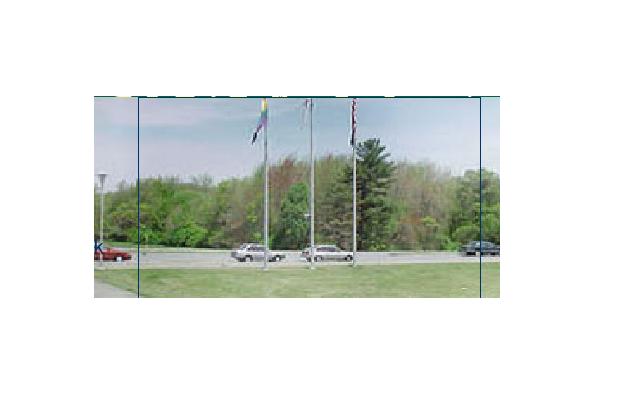
I apologize to all my loyal reader (love to ya, Monica) who apparently missed me. I've been busy Fighting For All That Is Good And Right (otherwise known as fighting to remember what all the pretty little buttons in Westlaw mean) as a law clerk (*ahem* intern) at Christian Law Association this week. I'd tell you how we are planning on Saving the World this summer, but then I'd have to kill you (or at least face some sort of confidentiality talking-to that might stay on my record), so instead I'll share an interesting circumstance a caller brought to our attention in the course of an unrelated call. Picture share (can be found at UMass-Dartmouth website):


In case you can't see exactly what this is, I'll explain: This is the front entrance to University of Massachusetts--Dartmouth campus. The flagpole in the center flies the Massachusetts state flag. On the right (yes, the right, not the center) is the United States flag. On the left is the rainbow flag, commonly known as the gay pride flag, and yes, it is being flown at the same height as the United States flag. Anyone want to play that game we learned from children's TV shows called "How Many Things Can You Find Wrong With This Picture"?

Thursday, June 15, 2006

Wednesday, June 14, 2006

Rocks, hold your peace just yet

Coming to you live from an internet cafe in Phoenix...

The last few days I've been sitting in some very interesting lectures on some very interesting topics given by some very credentialed people, and I figured I should post something about a point they raised or a controversy they inspired, but in retrospect the strongest impression that stands out to me has nothing to do with those lectures.

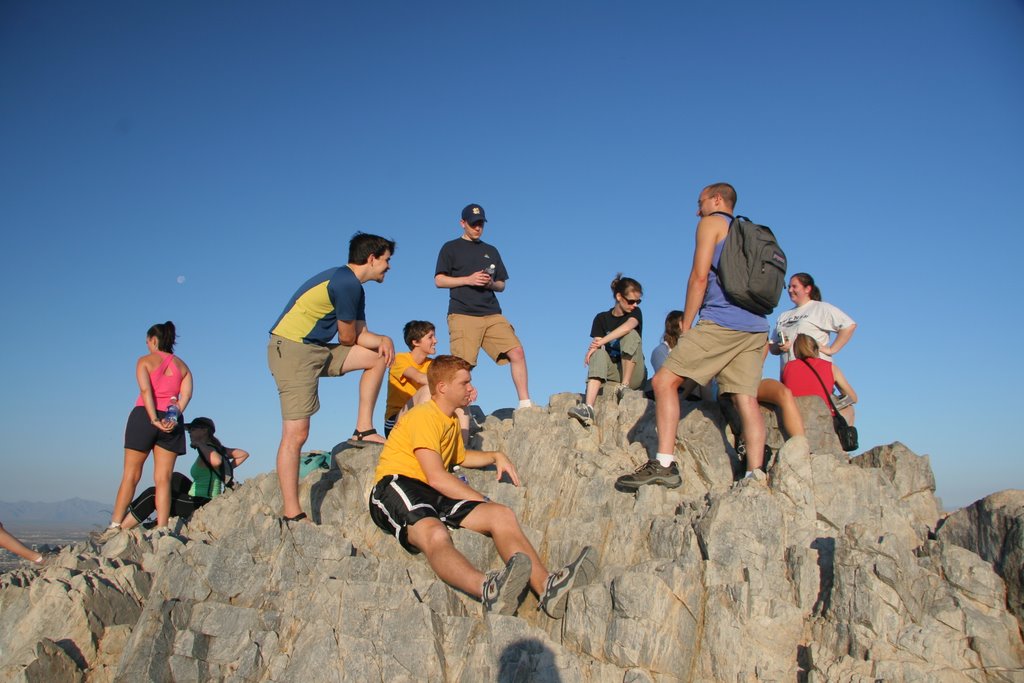
It happened this morning. A small group of us decided to go for a dawn hike up a nearby mountain since sessions started a little later. The timing worked out pretty well, and we reached the peak right about as the sun broke away from the horizon, and as all of us sat on the peak resting and basking in the beauty of Creation we started singing and reading aloud Psalms. It seemed like such a natural response none of us really thought twice about it. On the way back down, another hiker passed us. As he walked beside me for several paces he asked if we were a church group. I replied that no, we were law students, but we were Christians gathered from all over. He seemed absolutely baffled. "But you were singing up there," he said in puzzlement. "You're not a church?" But it's so logical: Christians gather, the Spirit is present; in the presence of so much natural beauty what could be more natural than that we be compelled to praise the Creator? I can't say for sure, but I don't think lost people really get that. Boy, do they miss out.

Tuesday, June 06, 2006

Sermon in Verse

Down With Fanatics!

If I had my way with violent men
I'd simmer them in oil,
I'd fill a pot with bitumen
And bring them to the boil.
I execrate the terrorist
And those who harbour him,
And if I weren't a moralist
I'd tear them limb from limb.

Fanatics are an evil breed
Whom decent men should shun;
I'd like to flog them till they bleed,
Yes, every mother's son,
I'd like to tie them to a board
And let them taste the cat,
While giving praise, oh thank the Lord,
That I am not like that.

For we should love the human kind,
As Jesus taught us to,
And those who don't should be struck blind
And beaten black and blue;
I'd like to roast them in a grill
And listen to them shriek,
Then break them on the wheel until
They turned the other cheek.

-- Roger Woddis

Monday, May 29, 2006

Endear Like a Champion!

I'm doing a little early recruiting.

Friday, May 26, 2006

Book reports

The Peacemaker, by Ken Sande
When I picked this book up I thought it would be more about arbitration and mediation with a Christian twist (based entirely on the prohibition against taking other Christians to court in I Cor. 6:1-8). While that passage is referenced a few times in the book, its scope is much more broad than that. Sande has a lot of good points about the inability of courts to address underlying problems in disputes and the damage this can cause in relationships among believers, but I really like the book's positive focus on what the church can, and should, do about it. He encourages churches to take an active role in maintaining healthy relationships within the church by overseeing conflict resolution and reconciliation. Most notable about this book is that it is not really about "legal" disputes. It is about relationships and ALL the conflicts that go with them, whether it's the breakdown of a contract, of a marriage, or kids fighting over the front seat of the car. It was challenging to me on a personal level because it pointed out the positive effects of conflict--greater understanding of and interaction with fellow-believers, and growth from the ability to reach God-honoring solutions. I don't like conflict and tend to deny it, run from it, or ignore it, and that is just as unhealthy to a relationship as belligerence. This book gets lots of stars on a scale of lots of stars.

Humility: True Greatness, by C.J. Mahaney
This book reminded me of one of those little coffee-table-type inspirational books you sometimes see at the checkout. I don't mean that in a disparaging way. It has good substance, even if it is a little repetitive and sometimes reads like an annotated bibliography. If you need a quick reminder and refocus on your exact position with reference to God (and who are we kidding, don't we all?), this book is a good choice. Watch out for some overt Calvinism, if that sort of thing bothers you. A respectable number of stars out of lots of stars.