We had the first dress rehearsal last night for the opera, and here's a piece of advice: Do yourself a favor and call the LaFortune Box Office at 574-631-8128 and buy yourself a ticket. It's $5-10 (probably depending on whether you are a student), 7:30 Thursday and Friday night. If you're afraid of terms like "opera," "aria," and "recitative," have no fear: this is in English, and a rather "updated" translation at that (think references to Clinton when the gods remind Jupiter of his follies). All the actors are students, and they are astoundingly good. I had trouble paying attention to the conductor because I kept wanting to see what was going on on stage. Oh, and the setting starts out as a hung over beach party. Offenbach would be proud. If you want more of the plot, read the synopsis. And ignore the Greek god bit--they use all the Roman names.
Update and correction: It would appear you can't actually buy tickets over the phone but must walk, with your ENTIRE body, over to the LaFortune box office to exchange money for admission. Also, as was pointed out to me, the performances are Friday and Saturday, not Thursday. Good to notice that now; they wouldn't have had a horn player Saturday!
Tuesday, April 04, 2006


Monday, April 03, 2006
Darned media's at it again...
If you have access to a library with a periodicals section, check out this week's issue of Chronicle of Higher Education (I'd post a link, but it's subscriber only and not worth the subscription). The cover article is an "expose" of Pensacola Christian College--"research" mostly gathered from disgruntled students, so you can imagine the tone. I frankly thought a lot of it sounded familiar. I do think from my own experiences on campus (my brother went there) and from talking to current students at my church that PCC does tend to be a little more strict than BJ in some areas, but the essence of the complaints does not really change. There were at least two fair criticisms, I think--an absolute distrust of students and a lack of any forum for disagreement. That being said, I thought the article horrible journalism. There was no indication that the author even attempted to interview a current student who was satisfied with the school or anyone officially affiliated with the school. That might have made the article at least LOOK fair and balanced. I'm sure anyone could write a scathing rant about any school if they got their story only from people who had been kicked out of it.
Frittering Away
Plug for the newly revitalized Frittering Away. The site's recent history is sketchy at best, but we'll pass over that at present. Perhaps one day the issues will be clear, but don't hold your breath. At any rate, it has been commandeered by a motley group of girls who plan to blather on about funny stories, stupid mishaps, and (it would seem) current weather. Come see us if you dare.
Friday, March 31, 2006
Poached theology
Poaching shamelessly from another's blog, I submit to you this article regarding the way Keswick theology has crept into American Christianity. To give credit where it is due, the article is linked through the blog of its author, Camille Lewis. I found it thought-provoking. It touches a lot of things I'm uneasy about in American Christian culture. It's like we're afraid of grace because we feel like we need the "guilt bat" to keep people in line. Smells a little like a lack of faith in the effectiveness of grace to produce "the fruits of the Spirit" on its own.
Wednesday, March 29, 2006
Restatement of a common-law dog
 I'm thinking about getting a dog. I know, I know, a bit premature--I don't even have an apartment where I can keep a dog right now, and I can't have a pet with me this summer. But maybe, one day... I've wanted a miniature pinscher since my horn teacher in high school got a pair. I've even thought about names. If I got a pair I'd call them Lexis and West, but I don't want a pair. If I got one, I could call it Restatement, because it's kind of like an abbreviated version of a common-law dog. I could call it Stacy for short. Or Abstract, and call it Abby. I thought about Brief, but that would sound to normal, non-law-nerd people like I named my dog after a pair of underpants. I found this group online that lets you adopt abandoned or rescued minipins, and feel in love with one in Indiana. Her name's Angel, and she's a couple years old, fully housebroken.
  The problem with adopting, though, is that the adoption contract does not convey a fee simple in the dog; you have to fulfill certain conditions in the care of the dog and they can repossess any time they feel like you're not up to snuff. I don't know if I want a pet with such encumberances.
I dunno, a dog is a big responsibility and I might be traveling some in the next few years and have no idea what living conditions my summers may bring. Also, I'm not sure how much the care would cost, especially of a pedigreed animal. Minipins usually cost $400-500 from a breeder, and then there are shots, sterilization, check-ups, food, extra housing deposit... But they're so cute! I'd love to be greeted at the door by a yapping little prince or have him snuggle on my lap while I study.
Tuesday, March 28, 2006
Upcoming Musical Offerings
Opera Notre Dame presents Orpheus Goes to Hell at 7:30 PM on April 7th and 8th. Tickets are $5-10. The production will be in English and probably be almost as edifying as it sounds.
Also, the Notre Dame Symphony Orchestra will be playing its Spring Concert Friday April 28. The info is not yet up on the DPAC page, but I'll provide a link when it is. Usually these concert are at 8 PM and cost $3 for students. The program includes a Greig piano concerto, Chausson violin concerto, and a couple Mozart orchestra pieces.
Also, the Notre Dame Symphony Orchestra will be playing its Spring Concert Friday April 28. The info is not yet up on the DPAC page, but I'll provide a link when it is. Usually these concert are at 8 PM and cost $3 for students. The program includes a Greig piano concerto, Chausson violin concerto, and a couple Mozart orchestra pieces.
International Economics
Probably everyone has read this at some point, but Tita sent it to me again, and I thought I'd post it for lighter reading, since I used the term "subject matter jurisdiction" in the last post...
TRADITIONAL ECONOMICS
You have two cows. You sell one and buy a bull. Your herd multiplies and the economy grows. You retire on the income.
INDIAN ECONOMICS
You have two cows. You worship them.
PAKISTAN ECONOMICS
You don't have any cows. You claim that the Indian cows belong to you.
AMERICAN ECONOMICS
You have two cows. You sell one and force the other to produce the milk of four cows. You profess surprise when the cow drops dead. You put the blame on some nation with cows & naturally that nation will be a danger to mankind. You wage a war to save the world and grab the cows.
FRENCH ECONOMICS
You have two cows. You go on strike because you want three cows.
GERMAN ECONOMICS
You have two cows. You reengineer them so that they live for 100 years, eat once a month and milk themselves.
BRITISH ECONOMICS
You have two cows. They are both mad cows.
ITALIAN ECONOMICS
You have two cows. You don't know where they are. You break for lunch.
SWISS ECONOMICS
You have 5000 cows, none of which belong to you. You charge others for storing them.
JAPANESE ECONOMICS
You have two cows. You redesign them so that they are one-tenth the size of an ordinary cow and produce twenty times the milk. You then create cute cartoon cow images called Cowkimon and market them worldwide.
RUSSIAN ECONOMICS
You have two cows. You count them and learn you have five cows. You count them again and learn you have 42 cows. You count them again and learn you have 17 cows. You give up counting and open another bottle of vodka.
CHINESE ECONOMICS
You have two cows. You have 300 people milking them. You claim full employment, high bovine productivity and arrest anyone reporting the actual numbers.
IRANIAN ECONOMICS
You have two cows. You choose one of them as the leader of your country and the other one as the president.
TRADITIONAL ECONOMICS
You have two cows. You sell one and buy a bull. Your herd multiplies and the economy grows. You retire on the income.
INDIAN ECONOMICS
You have two cows. You worship them.
PAKISTAN ECONOMICS
You don't have any cows. You claim that the Indian cows belong to you.
AMERICAN ECONOMICS
You have two cows. You sell one and force the other to produce the milk of four cows. You profess surprise when the cow drops dead. You put the blame on some nation with cows & naturally that nation will be a danger to mankind. You wage a war to save the world and grab the cows.
FRENCH ECONOMICS
You have two cows. You go on strike because you want three cows.
GERMAN ECONOMICS
You have two cows. You reengineer them so that they live for 100 years, eat once a month and milk themselves.
BRITISH ECONOMICS
You have two cows. They are both mad cows.
ITALIAN ECONOMICS
You have two cows. You don't know where they are. You break for lunch.
SWISS ECONOMICS
You have 5000 cows, none of which belong to you. You charge others for storing them.
JAPANESE ECONOMICS
You have two cows. You redesign them so that they are one-tenth the size of an ordinary cow and produce twenty times the milk. You then create cute cartoon cow images called Cowkimon and market them worldwide.
RUSSIAN ECONOMICS
You have two cows. You count them and learn you have five cows. You count them again and learn you have 42 cows. You count them again and learn you have 17 cows. You give up counting and open another bottle of vodka.
CHINESE ECONOMICS
You have two cows. You have 300 people milking them. You claim full employment, high bovine productivity and arrest anyone reporting the actual numbers.
IRANIAN ECONOMICS
You have two cows. You choose one of them as the leader of your country and the other one as the president.
Govnernment Speech and License Plates
Last week the 6th Circuit overturned a District Court decision that enjoined Tennessee from issuing "Choose Life" license plates. You can read the news article or look up the decision at 2006 WL 664372 (American Civil Liberties Union of Tennessee v. Bredesen--it's not in a reporter yet, obviously). The court classified the plates as "government speech" and allowed it. The way I understand it, the government is allowed to take certain positions (e.g. "Smoking is bad."). Here, though, the challengers claimed that the government was not taking a position but providing a forum for private citizens to take a position. Why this is somehow constitutionally worse eludes me. It seems to me that, if anything, private speech would be MORE protected than government speech (for example because it doesn't not have other restraints such as establishment of religion clause). Perhaps someone can explain that to me? At any rate, the court didn't buy the argument.
If you're taking Civil Procedure like me, there is a mildy interesting subject matter jurisdiction question in section II of the decision. Appellants tried to say that the state had reserved exclusive jurisdiction over claims arising from state tax laws, and this was such a claim. Court said forget it; the extra $10 the plate costs is voluntary, so it's more like a purchase from the state government than a tax.
Anyway, I know these kinds of plates have been challenged in other states, and I'm not sure if all the outcomes have been similar. If not, is this an important (or ripe) enough question for the Supreme Court to grant cert?
If you're taking Civil Procedure like me, there is a mildy interesting subject matter jurisdiction question in section II of the decision. Appellants tried to say that the state had reserved exclusive jurisdiction over claims arising from state tax laws, and this was such a claim. Court said forget it; the extra $10 the plate costs is voluntary, so it's more like a purchase from the state government than a tax.
Anyway, I know these kinds of plates have been challenged in other states, and I'm not sure if all the outcomes have been similar. If not, is this an important (or ripe) enough question for the Supreme Court to grant cert?
Thursday, March 23, 2006
More news from Central Park
Looks like we weren't the only out-of-town visitors in Central Park recently. Heh. New York doesn't seem to know exactly how to handle wildlife. It treats people less "humanely."
Monday, March 20, 2006
New York City

 Trust me, the St. Patrick's Day Parade is going on somewhere behind me. Poor guys. It was cold.
 Chris and Monica in Central Park. Awsome to see old friends, even if they are married :-). I've very much missed being able to run down to Monica's room for a girl chat at 10:50 and sneak back past the RA's at 11:01.
Ground Zero. They're going to start building on it soon. It's a little eerie to see this gaping hole in the middle of all the buildings.
Wednesday, March 15, 2006
Post-concert Celebration
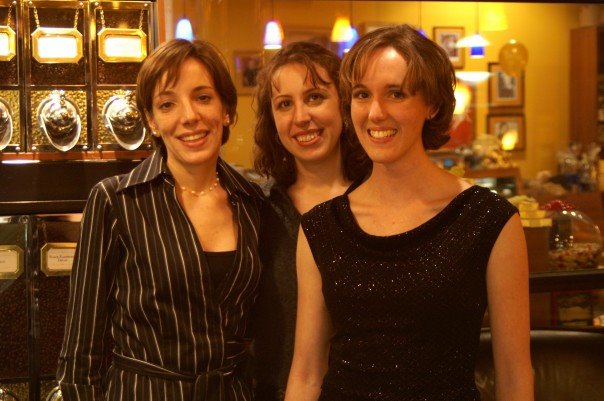 Angelita, Adele, and me at the South Bend Chocolate Factory after the Chieftains concert. Thanks for being there, Mom and Dad!
A- in Spring Break
It's amazing how much you can learn when school is not in session. Lessons so far this Spring Break:
1. Never trust online information, such as posted train schedules, if there is also printed information somewhere. Unless the company is run by people under the age of 30, more than likely they don't assume the internet is their customers' primary source of information.
2. Always check your flight plan (including airline and where it's leaving from) BEFORE you start figuring out how you're going to get there on time.
3. It is possible to drive from Chicago-O'Hare to Chicago-Midway in about an hour.
4. Never pack anything irreplaceable in a bag you're going to check. It could be days before you see it again (if ever).
5. Constitutional Law is far more fun when studied on the beach.
6. A cool bath with a little vinegar takes some of the sting out of a severe sunburn.
I should be getting course credit for this.
1. Never trust online information, such as posted train schedules, if there is also printed information somewhere. Unless the company is run by people under the age of 30, more than likely they don't assume the internet is their customers' primary source of information.
2. Always check your flight plan (including airline and where it's leaving from) BEFORE you start figuring out how you're going to get there on time.
3. It is possible to drive from Chicago-O'Hare to Chicago-Midway in about an hour.
4. Never pack anything irreplaceable in a bag you're going to check. It could be days before you see it again (if ever).
5. Constitutional Law is far more fun when studied on the beach.
6. A cool bath with a little vinegar takes some of the sting out of a severe sunburn.
I should be getting course credit for this.
Monday, February 27, 2006
Education Woes
Last weekend I attended the Norman Amaker Public Interest Law Retreat outside Indianapolis. I met lots of great students, teachers, lawyers, and other folks who try to make the world better, and have a renewed and reinforced interest in joining them.
One of the session topics was "Discrimination in Education," and a lot of difficult issues were raised in that session. The first was ESL students. One of the panelists pointed out (I think fairly) that schools often misdiagnose learning or behavior problems and fail to deal appropriately with them. For example, we expect a transient 4th-grader to learn English, but to ask a teacher to learn Spanish is "unrealistic," so the ESL teacher (who often doesn't know Spanish either!) becomes the "expert" any time there is ANY problem with the kid.
Another problem frequently identified is the obvious disparity between "rich schools" and "poor schools" (often labeled "Title I schools"). In New York, one district spends approx. $11,000 per pupil, while another (right across town) spends $3,000 per pupil. Clearly, one of those groups is at a disadvantage. One of the panelists was a former AmeriCorps teacher at a Title I school in NYC who said for the first two weeks she was short about 8 desks and had to have some of her 5th-graders sit on the rug (that she purchased). Her school of over 1,000 elementary students had ONE special needs teacher and TEN (!) child schizophrenics. 100% of the students were on free lunch. Um. Anyone see something wrong with this picture? Not meeting testing standards is the LEAST of this school's problems.
Third issue touched, relating to the second: vouchers. Almost everyone there was OVERWHELMINGLY against them. Their point: if you give people $2,000 to go to any school they want, (1) there may not be a better school available, and (2) if there is, they can guarantee it will cost more than $2,000. Hence, only the parents with means (who care to apply their money there) will be able to get their kids out of the "failing" schools, they will take their tax money with them, and leave all "the rest of them" to sink further. Something about that really bothers me. Call me a silly idealist, but I don't like the thought of there being a "the rest of them" in America.
Issue not touched but probably should have been: We threw the words "success" and "failing" around a lot, but never really defined them. What is a "failing" school? When can a student be said to have "succeeded"? Does it have to do with test scores? College admission? Happy and well-adjusted graduates (I challenge you to put a number on THAT)? My high school in Florida was great--if you were one of the privileged. We were an 'A' school--high rate of test passage, lots of AP students, college admission. But what about the "other" students at my school. Did they just get written off as that other 10% that, no matter what you do, just isn't ever going to look good on paper? I was given everything I could want at that school because I made it money. I passed AP tests, standardized tests, went to college. What about the students who didn't?
One of the session topics was "Discrimination in Education," and a lot of difficult issues were raised in that session. The first was ESL students. One of the panelists pointed out (I think fairly) that schools often misdiagnose learning or behavior problems and fail to deal appropriately with them. For example, we expect a transient 4th-grader to learn English, but to ask a teacher to learn Spanish is "unrealistic," so the ESL teacher (who often doesn't know Spanish either!) becomes the "expert" any time there is ANY problem with the kid.
Another problem frequently identified is the obvious disparity between "rich schools" and "poor schools" (often labeled "Title I schools"). In New York, one district spends approx. $11,000 per pupil, while another (right across town) spends $3,000 per pupil. Clearly, one of those groups is at a disadvantage. One of the panelists was a former AmeriCorps teacher at a Title I school in NYC who said for the first two weeks she was short about 8 desks and had to have some of her 5th-graders sit on the rug (that she purchased). Her school of over 1,000 elementary students had ONE special needs teacher and TEN (!) child schizophrenics. 100% of the students were on free lunch. Um. Anyone see something wrong with this picture? Not meeting testing standards is the LEAST of this school's problems.
Third issue touched, relating to the second: vouchers. Almost everyone there was OVERWHELMINGLY against them. Their point: if you give people $2,000 to go to any school they want, (1) there may not be a better school available, and (2) if there is, they can guarantee it will cost more than $2,000. Hence, only the parents with means (who care to apply their money there) will be able to get their kids out of the "failing" schools, they will take their tax money with them, and leave all "the rest of them" to sink further. Something about that really bothers me. Call me a silly idealist, but I don't like the thought of there being a "the rest of them" in America.
Issue not touched but probably should have been: We threw the words "success" and "failing" around a lot, but never really defined them. What is a "failing" school? When can a student be said to have "succeeded"? Does it have to do with test scores? College admission? Happy and well-adjusted graduates (I challenge you to put a number on THAT)? My high school in Florida was great--if you were one of the privileged. We were an 'A' school--high rate of test passage, lots of AP students, college admission. But what about the "other" students at my school. Did they just get written off as that other 10% that, no matter what you do, just isn't ever going to look good on paper? I was given everything I could want at that school because I made it money. I passed AP tests, standardized tests, went to college. What about the students who didn't?
Friday, February 17, 2006
If I may...
Inherently Funny Word
This was referenced in class today. Here is a small excerpt from the article. You may want to pace yourself for the whole thing, the references are quite extensive.
Determining whether a word is inherently funny, some say, is subjective and based on context. Therefore, there can never be a consensus on the answer of "What is funny?", or many other questions explaining the nature of such an abstract concept.
It is part of the mythology of actors and writers that the consonant plosives (so called because they start suddenly or "explosively"); that is: p, b, t, d, k, and g are the funniest sounds in the English language - particularly when found in short words since these "create the greatest tension" (tension being a key to comedy). Example: Underpants is funny, underwear is not. Shorter words are held to "create tension" because separating words from the normal flow of speech is very difficult cognitively, and it's more difficult to discern whether a short word has ended or not. Now look again at that list of funniest words. Duck is not only admirably short but both starts and ends in a plosive, and the other plosives are legion.
Additionally, the meaning of the word certainly plays a factor. "Duck" is funny in nearly every language, presumably because ducks are seen as a silly animal. Additionally, when taboos are associated with certain words, that can make a word humorous. The ideal funny word, then, would have the proper linguistic characteristics, a humorous meaning, and be well fitting the context of the situation and the character of the speaker.
This was referenced in class today. Here is a small excerpt from the article. You may want to pace yourself for the whole thing, the references are quite extensive.
Determining whether a word is inherently funny, some say, is subjective and based on context. Therefore, there can never be a consensus on the answer of "What is funny?", or many other questions explaining the nature of such an abstract concept.
It is part of the mythology of actors and writers that the consonant plosives (so called because they start suddenly or "explosively"); that is: p, b, t, d, k, and g are the funniest sounds in the English language - particularly when found in short words since these "create the greatest tension" (tension being a key to comedy). Example: Underpants is funny, underwear is not. Shorter words are held to "create tension" because separating words from the normal flow of speech is very difficult cognitively, and it's more difficult to discern whether a short word has ended or not. Now look again at that list of funniest words. Duck is not only admirably short but both starts and ends in a plosive, and the other plosives are legion.
Additionally, the meaning of the word certainly plays a factor. "Duck" is funny in nearly every language, presumably because ducks are seen as a silly animal. Additionally, when taboos are associated with certain words, that can make a word humorous. The ideal funny word, then, would have the proper linguistic characteristics, a humorous meaning, and be well fitting the context of the situation and the character of the speaker.
Tuesday, February 14, 2006
Obstetrics
The beginning of our obstetric pathology unit at school just happened to coincide with the Roe v Wade discussion here. Since I find this topic fascinating and somewhat relevant, I thought a spinoff post about the science of conception might be fun. I'll post things I think are interesting for a non-medical audience as I learn them, including carry-overs from our Roe v Wade thread.
Monday, February 13, 2006
Thursday, February 09, 2006
liter fare
If you haven't the time or taste for the discussion below, try this on for size! Gillette has just introduced a new razor with five (6 if you count the extra one on the back for those "tough to reach" spots) blades. 6 blades?!! I'm a one or two blade man, myself. I have used the tri-blade Mach 3 on occasion but 6? Is this going to far? Or is it a great advance for men everywhere who need to get those "tough to reach" spots? Blog away.
Roe v Wade
I beg your indulgences now, before I begin, for I have not the expertise to discuss the finer legal points of this ruling but must instead resort to its medical implications and mammoth symbolic significance. I have stated that although I consider myself to be pro-life, I do not wish for Roe v Wade to be overturned. My reasons for this relate to the relative safety of legal vs illegal abortion and the fact that legal abortion lends itself to tight regulation. Medically, a legal induced abortion in the first trimester is a relatively safe procedure. Many studies have attempted to estimate the relative risk of abortion-related mortality vs pregnancy-related mortality. All of these studies are limited by a tendency to undereport abortion-related deaths and the universally poorer overall health statistics of abortion recipients. Still most of the data indicate the risk of death related to normal pregnancy is at least an order of magnitude higher than the risk of death from legal induced abortion. Other defenses for the safety of legal abortion point to the high mortality rates for abortion prior to Roe v Wade and the persistently high mortality rates for abortion in countries where the procedure is illegal. Of course there are many confounding variables in this type of data which I can list for you, but I merely wanted to present an argument. I will not belabor the gorry details of procedures involved in performing an abortion unless specifically queried. I will submit, however, that Roe v Wade has tremendous psychological importance for a number of women who probably will never have an abortion. There are issues related to women's power and control over their bodies and their lives that make this ruling an important landmark apart from the specific procedure it addresses. Overturning Roe v Wade may send a damaging signal symbolically about how we have come to view women. I will be the first to say that everything within the power of the law should be done to limit the number of abortions that take place and the ease with which they can be obtained. I also firmly believe in the rights of the fetus, but I think pro-lifers may have more effective tools for fighting the battle against abortion than seeking for the upheaval of a ruling that, in the minds of many, is part of the cultural and legal history of this nation.
Soweto Gospel Choir
Soweto Gospel Choir at Notre Dame February 18 at 8pm. Tickets $30, $15 students. Order them today.
Tuesday, February 07, 2006
Erwin Chemerinsky
Last week the American Constitution Society of Notre Dame brought in Erwin Chemerinsky, Constitutional Law professor at Duke, to talk about the prospects of the Supreme Court with new additions Roberts and Alito.
His stated subject was, of course, predictive. He did throw in some very value-based comments regarding, among other things, abortion and affirmative action, but I suppose he and his sponsors were abundantly clear about his liberal identity, so we should perhaps expect as much and allow it. At any rate, I'll leave that and question instead his predictions.
Chemerinsky is obviously very intelligent. He was a good speaker, and relatively persuasive. That said, I don't buy all he had to say. Upon reflection, his views seem rather apocalyptic. Basically, now the court will overturn Roe v. Wade, return to segregation, allow rampant religious establishment, and let the President claim imperial power (are ALL those bad things?). Apparently Alito is a super-extremist and Bush should have chosen an O'Conner clone to save America from upheaval and right-wing tyrrany. I'm not so sure the sky is falling.
One: Overturning Roe v. Wade. That's pretty big, and I think the Court is aware of that. Overturning it would cause some serious political (not to mention cultural) fallout, and the Court won't do it lightly. If they do, is that so bad? If you are pro-life (*ahem* like me), you'll see it as a positive thing. If you're pro-choice, well, it just means now you get to lobby your state legislature instead of Congress (actually, that's true for pro-choicers, too).
As for the others, I don't think, even if Chemerinsky IS right about the balance of the court, we are not going to see as large-scale fallout as he seems to predict. Give the justices some credit, man. And the public. Life will go on. The battles may move to different grounds, but they will always be there. Have some coffee and relax.
Comments, you law nerds and law nerd wannabes?
His stated subject was, of course, predictive. He did throw in some very value-based comments regarding, among other things, abortion and affirmative action, but I suppose he and his sponsors were abundantly clear about his liberal identity, so we should perhaps expect as much and allow it. At any rate, I'll leave that and question instead his predictions.
Chemerinsky is obviously very intelligent. He was a good speaker, and relatively persuasive. That said, I don't buy all he had to say. Upon reflection, his views seem rather apocalyptic. Basically, now the court will overturn Roe v. Wade, return to segregation, allow rampant religious establishment, and let the President claim imperial power (are ALL those bad things?). Apparently Alito is a super-extremist and Bush should have chosen an O'Conner clone to save America from upheaval and right-wing tyrrany. I'm not so sure the sky is falling.
One: Overturning Roe v. Wade. That's pretty big, and I think the Court is aware of that. Overturning it would cause some serious political (not to mention cultural) fallout, and the Court won't do it lightly. If they do, is that so bad? If you are pro-life (*ahem* like me), you'll see it as a positive thing. If you're pro-choice, well, it just means now you get to lobby your state legislature instead of Congress (actually, that's true for pro-choicers, too).
As for the others, I don't think, even if Chemerinsky IS right about the balance of the court, we are not going to see as large-scale fallout as he seems to predict. Give the justices some credit, man. And the public. Life will go on. The battles may move to different grounds, but they will always be there. Have some coffee and relax.
Comments, you law nerds and law nerd wannabes?
Subscribe to:
Posts (Atom)